
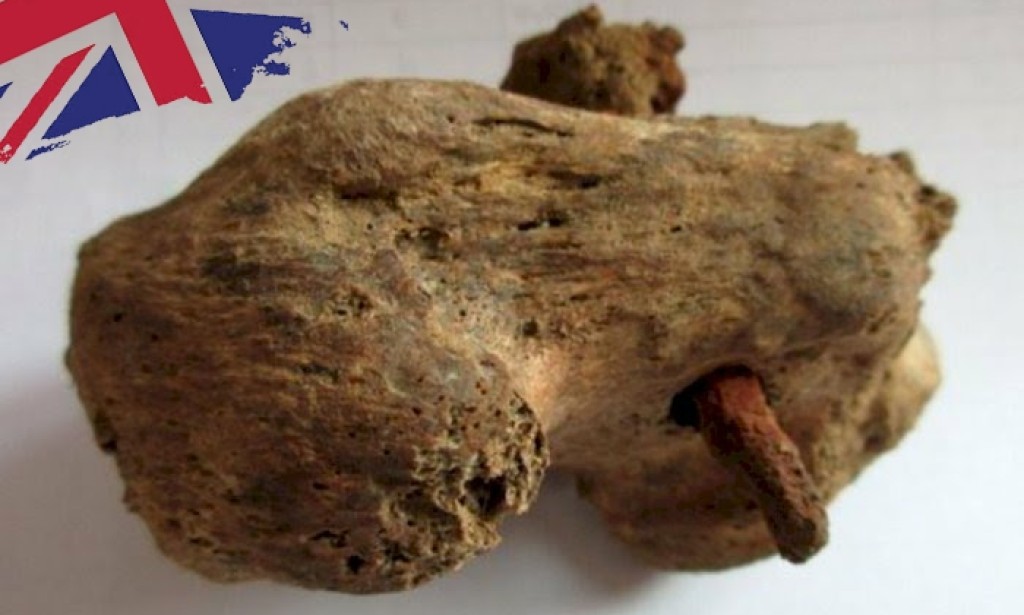
Archaeologists in England have found the skeleton of an unusual man. In the heel bone of his right foot, researchers found a nail that was still stuck. The skeleton of a man aged between 25-35 years was found at an archaeological site located between Cambridge and Huntingdon. David Ingham, an archaeologist from Albion Archeology then carried out excavations at the site which was a settlement named Fenstanton from the previously unknown Roman era.
He and his team found the remains of 40 adults and five children buried in five different graves dating to the third or fourth century AD. by the Romans. In addition to skeletons with nails driven into the heels of the feet, archaeologists have also found artifacts such as enameled brooches, bone combs, many coins, pottery, and the bones of slaughtered animals.
The sheer amount of wealth found at the site, along with evidence of trade, suggest that Fenstanton was a well-organized Roman-era settlement, possibly also a stopping point for travelers. There is one individual they think appears to have been crucified. The evidence is a large iron nail lodged in his right heel bone. Researchers say it is the first evidence of a Roman crucifixion ever found in England and also the first in northern Europe.
"The lucky combination of good preservation and the nails left in the bones have allowed me to examine the skeleton of this unique individual," said osteologist Corinne Duhig of Wolfson College who analyzes human bones.
The discovery of nails still embedded in the legs of the man's skeleton also shows that even people living in settlements far from the empire could not escape Rome's terrible punishment, namely crucifixion. This finding is important given the many stories of crucifixion, but the physical evidence of such practice is very rare.
"While there are many historical references and representations of images of the crucifixion, this is only the second time we have come across convincing physical evidence of how someone was crucified," said Ingham.
Crucifixion was a form of torture and slow execution that was eventually abolished by Constantine I in the 4th century AD. Iron nails were often removed from victims' bodies for reuse. However, in this case, the nail remained in place because it was bent and fixed in the bone. Meanwhile, skeletal analysis also showed that the man suffered before death. There was infection or inflammation caused by systemic disturbances or local irritation such as binding or shackles.
The man may have been involved in a crime considered so serious that he received the sentence of crucifixion. Analysis of other skeletal remains found at the site also paints a picture of poor health and wellness. Many of the skeletons show signs of dental disease, malaria, and evidence of physical trauma. Fractures were observed on many bodies, including a second elderly woman. his leg was broken at the same time. But researchers do not know clearly what causes it to happen.

You must be logged in to post a comment.