
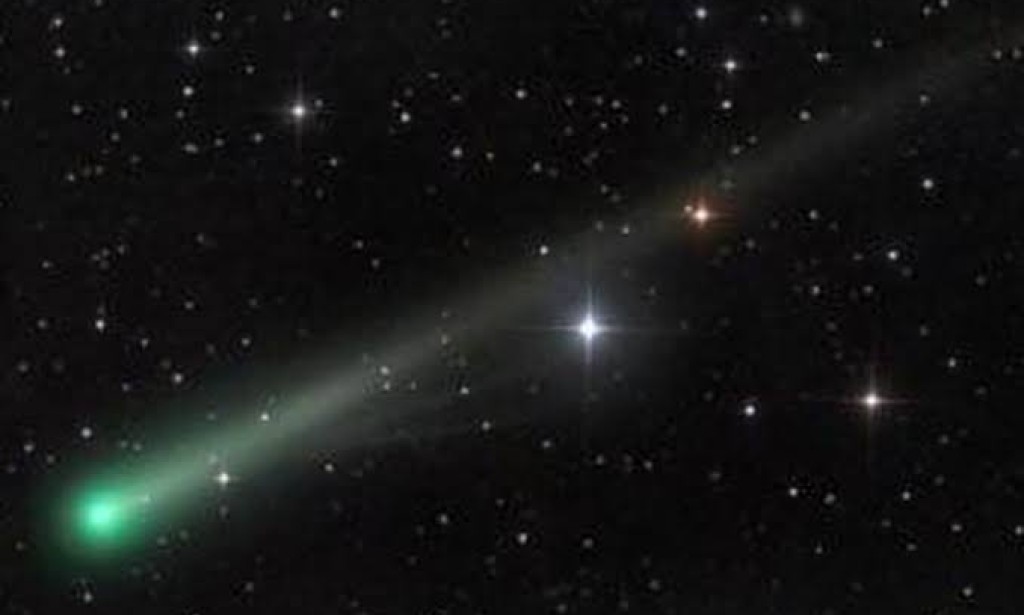
Physicists from UNSW Sydney have finally solved the puzzle of a comet emitting a green color. This discovery proves the results of research for 90 years since a scientist Gerhard Herzberg began researching the existence of the green color of comet heads starting in 1930.
The discovery was made in a journal published in the Proceedings of the National Academy of Sciences (PNAS). In their journal, they explained that comets are composed of various materials such as dust, ice and various gases, while the main gases are carbon monoxide and cyanogen which are generally toxic materials. for humans. These materials and gases will act when exposed to sunlight as scattered and evaporated. Evaporation causes the comet to appear to have a red tail with a green head.
"We have proven the mechanism by which carbon reacts by sunlight," said Timothy Schmidt, professor of chemistry at UNSW Science.
According to Schmidt, carbon is very reactive and has a role in creating the green color of comets. The material consists of two carbon atoms that are in contact with each other and can only be found in low oxygen environments such as in space. This means that the closer the comet is to the sun, the more ultraviolet radiation will destroy the comet's carbon molecules. In this process is called photodissociation or photolysis which is a chemical reaction process with the help of light or photons. Practically this process destroys the carbon in the comet before it can move away from the nucleus. The comet will also shrink and lose its tail. Experts also ensure that the green color does not reach the comet's tail because it evaporates faster at the head of the comet.
"I'm amazed that someone in the 1930s thought about this, to the level of detail of the mechanism by which it happened, and then 90 years later, we discovered that this process happened," said Ms Jasmin Borsovszky, author and former student of UNSW Science.
Experts explain the level of green on a comet will differ depending on the gas content. There are about 3,700 comets detected in the solar system, although there are thought to be billions of them.

You must be logged in to post a comment.